




Azhar Shahzad
Administrators
-
Joined
-
Last visited
-
Advantages of steel construction1. ReliabilitySteel structures are very reliable. The reasons for this reliability include consistency and uniformity in properties, better quality control because of factory manufacture, large elasticity, and ductility. If different specimens of some types of steel are tested in the laboratory for yield stress, ultimate strengths and elongations, the variation is much lesser than other materials like concrete and wood. Further, because of truly homogeneous and elastic material, steel satisfies most of the assumptions involved in the derivation of the analysis and design formulas and the results obtained and reliable. This may not be the case in concrete structures because of heterogeneous material, cracking and non-linearity of stress-strain relationship. 2. Industrial behaviorRolled steel sections are manufactured in factories. Also, the members may be cut and prepared for assembly in factories wile only joining of these components is carried out at the site by installing rivets or bolts and by welding different components. Sometimes parts of the structure are also assembled in the factories, that is, there is a great adaptation to prefabrication. Manual errors reduce greatly in such cases, the speed of construction increases, and the total cost reduces. 3. Lesser construction time / greater erection speedBecause of the industrial nature of steel construction. Progress of the work is fast making the structures economical. The reason is that these structures can be put to use earlier. The reduction in labor cost and overhead changes and the benefits obtained from the early use of the building contribute to the economy. 4. High strength and light weight natureThe high strength of steel per unit weight means that the dead loads will be smaller. It is to be noted that dead loads are a bigger part of the total loads on structure. When dead load reduces, the underneath members become still smaller due to less weight acting on them. This fact is of great importance for long-span bridges, tall building, and for structures having poor foundation conditions. 5. Uniformity, durability and performanceSteel is a very homogeneous and uniform material. Hence, it satisfies the basic assumptions of most of the analysis and design formulas. If properly maintained by painting, etc. the properties of steel do not change appreciably with time, whereas the properties of concrete in a reinforced concrete structure are considerably modified with time. Hence, steel structures are more durable. 6. ElasticitySteel behaves closer to design assumption than most of the other material because it follows Hooke’s law up to fairly high stresses. The stress produced remains proportional to the strain applied oft the stress-strain diagram remains a straight line. The steel sections do not crack or tear before ultimate load and hence the moments of inertia of a steel structure can be definitely calculated. The moments of inertia obtained for a reinforced concrete structure are rather indefinite. 7. Ductility and warning before failureThe Property of a material by which it can withstand extensive deformation without failure under high tensile stresses is said to be it ductility. Mild steel is a very ductile material. The percentage elongation of a standard tension test specimen after fracture can be as high as 25 to 30%. This gives visible deflections of evidence of impending failure in case of overloads. The extra loads may be removed from the structure to prevent collapse. Even if collapse does occur, time is available for occupants to vacate the building. In structural members under normal loads, high stress concentrations develop at various points. The ductile nature of the usual structural steel enables them to yield locally at those points, thus redistributing the stresses and preventing premature failures. 8. Additions to existing structuresAdditions to existing steel structures are very easy to be made. Connections between new and existing structures can be employed very effectively. New bays or even entire new wings can be added to existing steel frame building, and steel brides may often be widened. 9. Possible ReuseSteel sections cab be reused after a structure is disassembled. 10. Scrap valueSteel has a scrap value even though it is not reusable in its existing form. 11. Water-tight and air-tight constructionsSteel structures provide completely impervious construction and structures like reservoirs, oil pipes, gas pipes, etc. are preferably made from structural steel. 12. Long span constructionHigh-rise buildings, long span bridges and tall transmission towers are made up of structural steel. Industrial buildings up to a span of 90.m can be designed by plate girders or trusses. Bridge spans up to 260.m are made with plate girders. For through truss bridges, Bridge spans of 300.m have been used. 13. Temporary constructionFor temporary structures, steel construction is always preferred. Army constructions during war are mostly made out of structural steel. The structures may be disassembled by opening few bolts, component parts are carried to new places are the structure is easily reassembled. Disadvantages of steel construction1. High maintenance costs and more corrosionMost steels are susceptible to corrosion when freely exposed to air and water and must therefore be periodically painted. This requires extra cost and special care. The use of weathering steels, in stable design applications, tends to eliminate this cost. If not properly maintained, steel members can lose 1 to 1.5 mm of their thickness each year. Accordingly, such constructions can lose weight up to 35% during their specified life and can fail under the external loads. 2. Fireproofing costsAlthough steel members are incombustible, their strength is tremendously reduced at temperatures prevailing in fires. At about 400ºC, creep becomes much more pronounced. Creep is defined as plastic deformation under a constant load for a long period of time. This produces excessively large deflections/deformations of main members forcing the other members to higher stresses or even to collapse. Steel is an excellent conductor of heat and may transmit enough heat from a burning compartment of a building to start fire in other parts of the building to start fire in other parts of the building. Extra cost is required to properly fireproof the building. 3. Susceptibility to bucklingThe steel sections usually consist of a combination of thin plates. Further, the overall steel member dimensions are also smaller than reinforced concrete members. If these slender members are subjected to compression, there are greater chances of buckling. Buckling is a type of collapse of the members due to sudden large bending caused by a critical compressive load. Steel when used for columns is sometimes not very economical because considerable material has to be used merely to stiffen the columns against buckling. 4. Higher initial cost / less availabilityIn few countries, steel is not available in abundance and its initial cost is very high compared with the other structural materials. This is the most significant factor that has resulted in the decline of steel structures in these countries. 5. AestheticsFor certain types of buildings, the steel form is architecturally preferred. However, for majority of residential and office buildings, steel structures without the use of false ceiling and cladding are considered to have poor aesthetic appearance. A considerable cost is to be spent on such structures to improve their appearance. Cladding is a covering of metal, plastic or timber put on the surface of a structural member to completely encase it. The cladding not only protects the member but also improves its appearance.
-
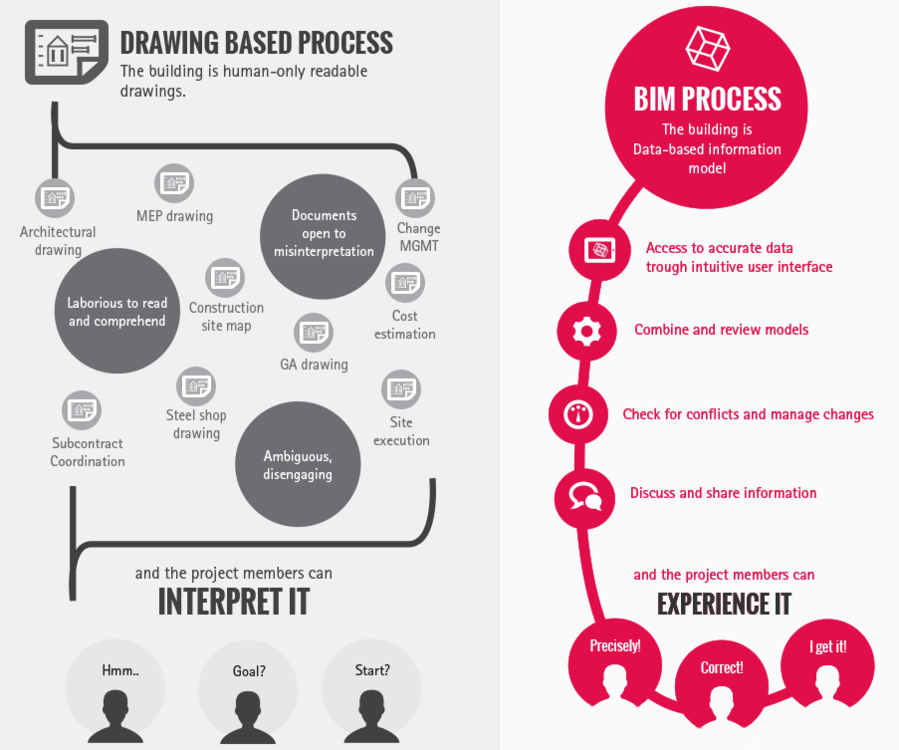
Definition of BIM: Building information modelling (BIM) is a digital representation of physical and functional characteristics of a facility. A BIM is a shared knowledge resource for information about a facility forming a reliable basis for decisions during its life-cycle; defined as existing from earliest conception to demolition. BIM benefits: Faster drafting without loss of cost and quality High level of customization and flexibility Optimization of schedule and cost Seamless coordination and collaboration Conflict detection and risk mitigation Easy maintenance of building life cycle Here is the nice info-graphic which compares BIM based process to the 2D drawings based process: Learn more about BIM solutions for structural engineers

-
1. BIM will be the backbone of future Construction Building Information Modeling is taking over the industry globally at the speed of light. In the UK, for example, the industry adoption rate has boomed from 13% in 2010 to 39% in only two years and many countries are introducing initiatives such as national BIM recommendations to push the adoption forward. It is reasonable to expect this trend to continue as the construction industry recovers from recession and as BIM continues its path towards becoming an industry requirement. Whether you are studying structural engineering, construction engineering or architecture, expect BIM to be a major factor and competitive advantage upon graduation. 2. The "I" in the BIM will become even more Significant While impressive illustrations and 3D models are a highly visible part of BIM, robust opportunities for collaboration, coordination, fabrication, as well as, integration to production automation systems and machinery is what really puts the “I” in BIM. Information management and Integration between models allows each professional to focus on what they do best while simultaneously improving clash checking and accuracy. BIM makes relevant information available to everyone when they need it. Models become more than a sum of their parts, making BIM a highly attractive tool for both companies and professionals in related industries. 3. The Industry will look for BIM experts instead of CAD Assistants With the industry changing at a rapid pace, companies start looking for skilful BIM users to keep up with this speed of change. To mention a few sought-after skills, employers start looking for experts who can create and develop different models and perform analyses and simulations based on these models. Companies who are at early adoption stages of BIM are looking for BIM specialists who are capable of implementing BIM, managing and modeling all project information and also educating others within the organization. Academia and schools need to meet this demand by delivering a new generation of professionals who are fluent in BIM. 4. With BIM You will... Practically everyone involved in the design and construction process will gain benefits from BIM. Engineers, architects and contractors can virtually walk through construction models, explore structural components and details, and identify any potential design, construction or operational issues. BIM allows builders to bring even to the most complicated structures into reality by enabling the high detail modeling of multiple materials while simultaneously saving time, resources and space. Users will be able to focus on the essential instead of the menial. Learn more about BIM solutions for structural engineers

-
Study some basic mathematical topics like Geometry, Vectors, and Matrices etc. It will greatly increase your understanding towards engineering mechanics. Must read relevant theory first before attempting problems. Start from easy problems then go on as your concepts developed.
-
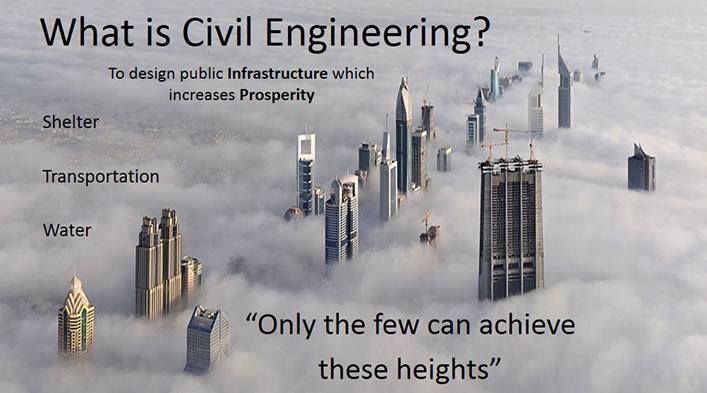
By building up environment Civil Engineers play with nature... Civil engineering is a professional engineering discipline that deals with the design, construction, and maintenance of the physical and naturally built environment, including works like roads, bridges, canals, dams, and buildings. Why Become a Civil Engineer? 1. Civil engineers create the world around us Civil engineers are the unsung heroes of the engineering world. Yet this jack-of-all-trades discipline is an incremental part of creating everything from tall skyscrapers and complex stadiums to bridges, railways and tunnels. As a civil engineer, your work influences where people work, relax, learn and live. You will be a part of helping society to become more advanced by adapting the infrastructure to meet challenges brought on by new technologies, population growth and climate change. Civil engineers know that even the simplest structure can include hundreds of “unknowns” which they have to be able to identify and solve in order to ensure the structure is operational, stays safe and stands the trial of use, environment and age. In addition to all this, civil engineers also play a key role during emergencies like droughts or natural disasters by helping those affected to recreate their living environment and the infrastructure that provides for their basic needs. 2. Civil engineers never have a dull moment Civil engineers can work in a versatile range of positions and projects. Civil engineering specializations such as structural, environmental, geo-technical and transportation engineering all entitle challenging, constantly changing work environments and require creativity, adaptability, good problem-solving skills and ability to think on one’s feet. As a civil engineer, despite your area of specialization, you need to be sensitive to local and environmental challenges as well as to the requirements of different construction project participants. You need to have attention to detail while simultaneously understanding “the bigger picture”. In addition to the wide spectrum of challenges, the versatility of projects civil engineers can participate in ensures that you are unlikely to have a dull moment at work. You can work below the surface delivering tunnels, underground railways and energy and water supplies as well as above the surface creating roads, bridges, stadiums, hospitals, skyscrapers and many more. As a civil engineer, you are likely to be constantly on the move, sharing your time between the site, the office and perhaps even different geographical locations. 3. Civil engineers have a monument to show that they were there While civil engineering can be somewhat stressful, the profession includes a huge sense of accomplishment to make it all worthwhile. Throughout history, civil engineers have participated in some of the most ambitious and incremental projects known to mankind. World-known ventures such as the Hoover Dam, the Great Wall of China and the Hardanger Bridge are tokens of the hard work and expertise of civil engineers. While you might have to start your civil engineering career with slightly smaller projects, the fact remains that by the end of the day you will have a monument to prove that "you've been there". You know all the challenges and effort that went into transforming the blueprints into a fully functional structure. What do you think about Civil Engineering?
-
-
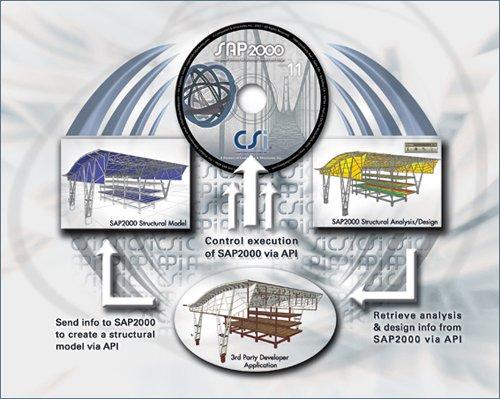
Recently, Computer and Structutes Inc. has announced the Open Application Programming Interface (OAPI) feature for its product SAP2000. With this feature user will be able to access SAP2000 by an external appplication with help of any supporting programming language (e.g Visual Basics). Here are the basics how this feature is utilized at professinal level: You create structural model in the custom (external) application. Send the info for structural model into SAP2000 with API (Use your favourite Programming Language). Access the desired features of SAP2000 and execute the analysis or design operations. Then retrieve analysis or design results from SAP2000 into custom application. Use output results in your application. Following flow chart provides more understanding towards the use of SAP2000 OAPI: All the hardwork is done by SAP2000 and all features of SAP2000 can be utilized by an external application. Same can be accomplished using Excel and VBA (Visual Basics for Applications) to which almost every Civil Engineer might be familiar. Using OAPI, user who wants to develop their own structural analysis & design applications can make use of robust numerical methods of SAP2000 into their applications with ease. So far, this feature is not available for all Computer and Structures Inc. products family. In future OAPI will also be available for ETABS, model created in SAP2000 can be transfer and reuse in ETABS. Computer and Structures Inc. provides a subscription for developers who would like technical support for building and integrating their applications with SAP2000. Qualified developers can also get free licenses for integration purposes. For more information visit CSI Developer Network (CSIDN).
-
It is the figured formed during a process to magnify the length of a short base line to make it compatible with much longer lines of triangulation networks. Base Net usually form a rhombus, in which short diagonal serves as the base line and long diagonal serves as the base side of the triangulation.