




Jump to content
View in the app

A better way to browse. Learn more.

Structural Community

A full-screen app on your home screen with push notifications, badges and more.

To install this app on iOS and iPadOS
  1. Tap the Share icon in Safari
  2. Scroll the menu and tap Add to Home Screen.
  3. Tap Add in the top-right corner.
To install this app on Android
  1. Tap the 3-dot menu (⋮) in the top-right corner of the browser.
  2. Tap Add to Home screen or Install app.
  3. Confirm by tapping Install.
A group blog by Structural Community in Civil and Structural Engineering
  • Entries

    23
  • Comments

    0
  • Views

    19,693

Contributors to this blog

About this blog

Use this category to post articles, tips and tricks you've learned. Any topic covering civil & structural engineering is acceptable.

Entries in this blog

A tunnel is an elongated, narrow essentially linear underground opening with a length greatly exceeding its width or height. Most tunnels are nearly or exactly horizontal but for special purposes, tunnels may be driven at angles up to 30 degrees from the earth's surface. The one which is greater than 30 degrees from horizontal are designed as shafts. When rocks in tunnels are highly in-competent, especially when underground water is present, tunneling becomes a very costly and hazardous operatio
Tunnel sections Tunnels range in dimensions of cross-sections from those of small galleries driven by miners working with hand tools, to tunnels large enough to accommodate railroad trains, double lane of highway traffic, or to transport very large volume of water as in diversion structures in dams. A minimum size of tunnel is 9 ft high and 4 ft wide at the working face. Designed shapes or sizes of tunnels in x-section conform to a planned uses to tunnel and some extent to the nature of the mate
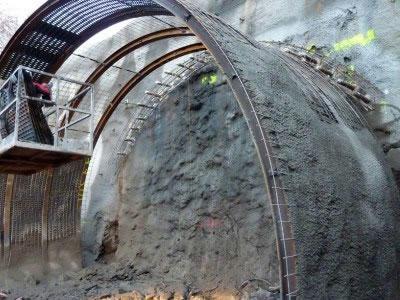
Rock support for tunnels and underground cavern design is a demanding and very complex task. In principle, the problem can be approached from two directions: The first way is to define the relationship between geo-mechanical properties of the rock mass and the support methods used. This is mostly based on the utilization of statistical and empirical data gathered in similar conditions. The second way is to estimate the deformation characteristics of the rock structure, and then the related effec

Important Information

By using this site, you agree to our Privacy Policy.

Configure browser push notifications

Chrome (Android)
  1. Tap the lock icon next to the address bar.
  2. Tap Permissions → Notifications.
  3. Adjust your preference.
Chrome (Desktop)
  1. Click the padlock icon in the address bar.
  2. Select Site settings.
  3. Find Notifications and adjust your preference.